

Lehenga and Wedding Outfit Dry Cleaning in Delhi: Cost, Care and What to Do Before and After the Wedding
A lehenga is usually the most expensive thing in the wardrobe and the one that is worn the least, which is exactly why it gets cleaned wrongly: too late, at home, or not at all before it goes back in the box. This guide covers what lehenga dry cleaning costs in Delhi, what can and cannot be washed at home, how far ahead to send outfits before a wedding, what to do about haldi, mehendi and food after it, and how to store a lehenga so it is still wearable in ten years.
The thirty-second version
- Cost: lehenga dry cleaning is ₹1,000 at Laxmi Nagar, and a steam press alone is ₹300. Heavily worked bridal pieces and sherwanis are priced on inspection.
- Wash at home? Only a plain cotton or printed lehenga with no embroidery, lining or can-can. Anything with zari, sequins, stones, mirror work, silk, velvet or net goes to a dry cleaner.
- Before the wedding: take the outfit out three to four weeks ahead. Send it for cleaning at least a week before the function; a press needs only a day.
- After the wedding: blot, do not rub, and send it within a few days with a note of what got on it. Haldi and mehendi set fast.
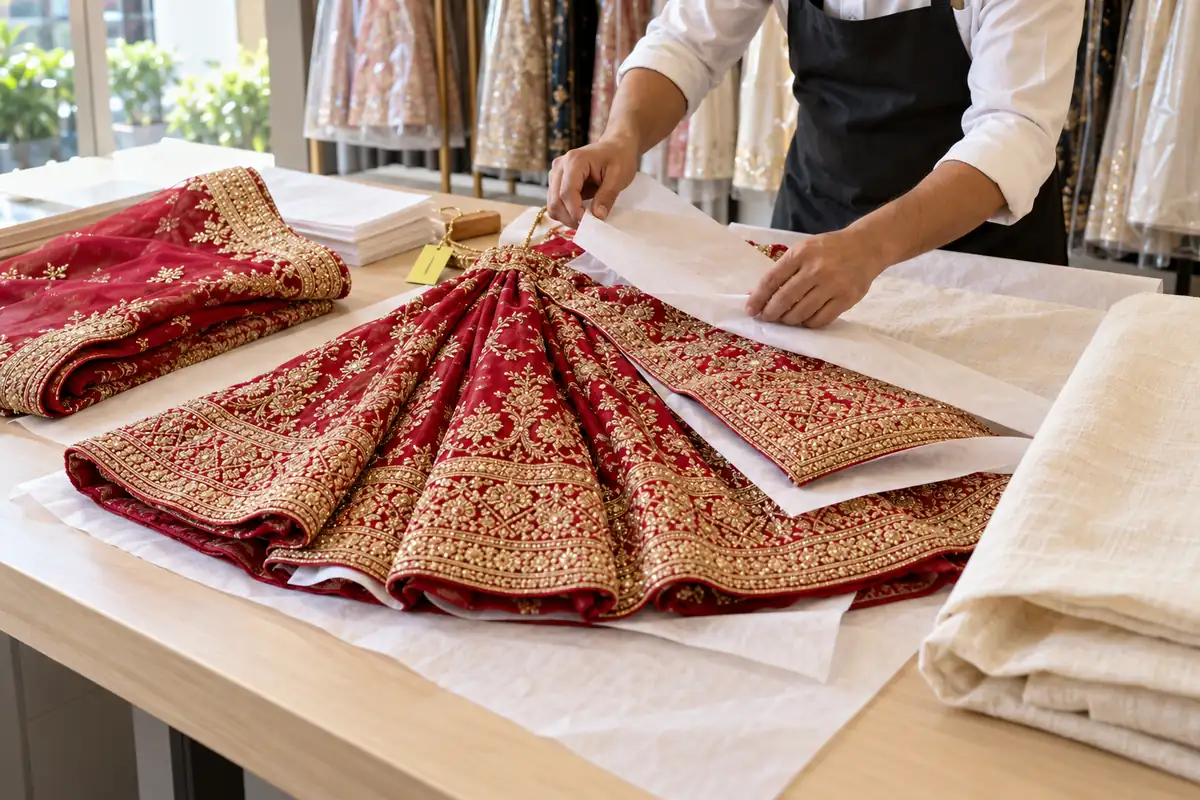
- Storage: cleaned first, folded flat in muslin with tissue in the folds, never in plastic and never hung by the waistband for months.
Why a lehenga is not one garment
A lehenga set is three or four garments made of different materials, sewn and glued together, and each part reacts to water and heat differently.
- The skirt is several layers: the face fabric, often silk, georgette, net or velvet; a lining; and frequently a can-can or stiffened net underneath for volume. A bridal skirt can weigh several kilos dry and far more wet.
- The embellishment is where the value is and where the damage happens. Zari and zardozi are metal-wrapped threads that tarnish in water. Sequins, stones and mirror work are often fixed with glue that softens in warm water and detergent. Gota patti is metallic ribbon that dulls and puckers.
- The blouse or choli takes the sweat, deodorant and perfume, usually in the underarms and along the back, and is often the dirtiest part of the set.
- The dupatta is the lightest and the most likely to pick up food, mehendi and floor dirt, because it trails.
Every layer shrinks, bleeds and dries at its own rate. That is why a lehenga that survives a home wash still often comes out with a puckered hem, a lining that hangs below the skirt, or a pink tint across a cream border.
Can you wash a lehenga at home?
| Lehenga type | Wash at home? | Why |
|---|---|---|
| Plain or printed cotton, no lining | Yes, cold hand wash | Mild liquid detergent, no wringing, dry flat in shade |
| Rayon or chanderi with light thread work | Risky | Rayon shrinks and goes stiff when wet; colours often run |
| Georgette, chiffon or net | No | Loses shape and drape; net layers tangle and tear |
| Silk, Banarasi or brocade | No | Silk weakens when wet, dyes bleed and zari tarnishes |
| Velvet | No | Water crushes the pile and it does not recover |
| Anything with sequins, stones, mirrors or gota | No | The glue softens, pieces fall off, metallic trims dull |
| Zari or zardozi embroidery | No | Metal threads tarnish and blacken, especially on fold lines |
| Any skirt with a can-can or attached lining | No | Layers shrink at different rates; the hem never sits straight again |
If you do wash a plain cotton lehenga, test a hidden seam for colour first, wash it on its own, never put it in a machine with the dupatta, and dry it flat in the shade, not on a line in Delhi sun. For everything else, one professional clean costs a small fraction of what the outfit did. The fabric reasoning is the same one explained in our dry clean vs wash guide.
What lehenga dry cleaning costs in Delhi
| Item | Dry cleaning | Steam press only |
|---|---|---|
| Lehenga | ₹1,000 | ₹300 |
| Saree | ₹230 | ₹60 |
| Blouse | ₹60 | — |
| Dupatta | ₹100 | ₹30 |
| Dress | ₹250 | ₹50 |
| Kurta | ₹120 | ₹30 |
| Salwar | ₹110 | ₹30 |
| Shawl / pashmina | ₹300 / ₹600 | ₹50 (shawl) |
| Suit, 2 piece / 3 piece | ₹335 / ₹440 | ₹110 / ₹130 |
| Sherwani, bandhgala, heavily worked bridal pieces | Priced on inspection | Priced on inspection |
Laxmi Nagar outlet, per piece, after the standard 20% discount that applies to every order with no minimum. Dry cleaning takes 72 hours as standard and a steam press 24 hours. Whether a set’s blouse and dupatta are counted within the lehenga price is confirmed when the outlet sees the set. Prices may vary — please confirm the current rate with the outlet before booking. Every other garment is in our Delhi laundry and dry cleaning cost guide, which has a calculator.
Lehenga prices vary a great deal across Delhi, and the spread comes down to three things: how much handwork there is, how many layers the skirt has, and what stains need treating by hand before the clean. A bridal lehenga with dense zardozi and a three-layer skirt is a different job from a light georgette lehenga worn to a sangeet, which is why the heaviest pieces are priced after someone has looked at them, not from a list. A single lehenga is already over the ₹500 threshold for free pickup and delivery.
Before the wedding: a timeline that avoids the November rush
From November to February, every dry cleaning counter in Delhi is full of lehengas, sarees and sherwanis, all wanted back by the same Saturday. The families who are not panicking the night before are the ones who started early.
Three to four weeks before
Take every outfit out of its box or cover, including the ones you wore last season. Try them on. Look for fold lines that have set, zari that has gone dark along the folds, a musty smell, loose stones or beads, and small holes, which in silk and wool usually mean moths or silverfish. Anything stained, smelly or put away without cleaning goes for dry cleaning now, while counters are quiet and 72 hours really is 72 hours.
One week before
This is the last comfortable moment to send anything for a full clean. It leaves time for a second pass on a stubborn mark, which a three-day margin does not. Outfits that are clean but creased from storage only need a steam press, which comes back in 24 hours.
The day before
Hang the outfit in a breathable cotton cover, out of the sun, away from the kitchen and away from the dressing table. Spray perfume and deodorant before you dress and let it dry, not onto the fabric: the alcohol leaves marks on silk that look like water stains and do not always come out. If you are steaming at home, hold the steamer a few inches from the fabric and keep it off zari, sequins and stones.
Need it faster? Ask about express service when you book. Whether a particular piece can be done on express depends on the work and the stains, and the outlet confirms the price and the time before we collect anything.
After the wedding: the stains, and what actually works
A wedding outfit collects more in one evening than most clothes do in a year. The single most useful thing you can do is send it within a few days, with a note of what happened where. Almost every wedding stain is easier to remove in the first week than in the first month, and a stain that has been ironed or stored becomes permanent.
| Stain | What to do now | What to expect |
|---|---|---|
| Haldi (turmeric) | Scrape off any paste dry; do not wet it, do not use soap | Hard on silk; light marks often lift, deep yellow on silk may not |
| Mehendi | Let it dry, brush off the crust outdoors | The dye bonds to fibre; nobody can promise full removal |
| Gravy, ghee and sweets | Blot with a dry tissue; no water on silk or zari | Usually removable if treated within days, before the oil oxidises |
| Sweat and deodorant at the blouse | Air the blouse inside out; do not store it as it is | Fresh marks clean well; old yellowing on silk may stay |
| Lipstick, kajal and foundation | Do not rub; it spreads into the weave | Usually removable by hand spotting |
| Candle or diya wax | Let it harden, lift the loose wax gently | The wax comes off; the oil ring underneath needs treatment |
| Mud and grass on the hem | Let it dry, shake and brush lightly | Usually comes out; send the dupatta too, it trails |
| Wine, cold drinks and tea | Blot; do not add salt, soda or water on silk | Good chance if treated quickly |
What not to do is the same for all of them: no rubbing, no water on silk or zari, no hair dryer, no ironing over the mark, and no household remedies. Each stain is treated by hand on a spotting board before the clean, and it helps a great deal to know what it is. For cotton and everyday clothes, the first-aid steps are in our stain removal guide.
Diwali and festival wear
The festive season is harder on ethnic wear than weddings are, because the same outfit often goes to three functions in a week. Diwali brings its own problems: diya oil on dupattas, wax on the hem, ghee from sweets, and smoke from firecrackers that settles into silk and velvet. Sparks leave small burn holes that no cleaning can repair, so keep a dupatta tucked in near diyas and firecrackers. Between functions, air the outfit inside out overnight in the shade and spot-check it in daylight before it is worn again. If it was only worn for a few hours and there are no marks, a steam press is often enough; if there is oil, food or a smell that does not air out, send it before it is folded away. Sarees have their own guide: how to wash, press and store every kind of saree. For curtains, rugs and the rest of the house, see our Diwali cleaning checklist.
Sherwanis and the groom’s side
Sherwanis, bandhgalas and Nehru jackets are treated like the embellished garments they are: handwork protected, buttons covered or removed, cleaned gently and hand finished. They are priced on inspection, because a plain bandhgala and a zardozi sherwani are entirely different amounts of work. The same rule applies after the wedding: send it within a few days, before haldi, food and perfume set. Two-piece and three-piece suits, blazers and coats are covered in our suit and blazer dry cleaning guide.
How to store a lehenga so it lasts
Most of the damaged lehengas we see were damaged in the cupboard, not at the wedding. Zari cracks along a fold that has not moved in years, sweat left in a blouse turns yellow and weakens silk, and a lehenga sealed in plastic through a Delhi monsoon comes out with mildew.
- Clean it before storing it. Stains that cannot be seen yet, especially sweat and sugar, darken and attract insects in storage.
- Fold, do not hang, for long storage. A heavy skirt hung by its waistband for months stretches the waistband and pulls at the seams. Lighter lehengas can hang on a padded hanger by their hanging loops for a season.
- Wrap it in muslin or soft cotton, never plastic. Put tissue or a thin cotton cloth inside each fold so embroidered surfaces do not rub against each other.
- Keep the can-can loose and do not crush it under other boxes; it holds its shape better that way.
- Refold every two to three months along different lines, so no crease sets and no zari cracks.
- Use neem or camphor in a pouch that does not touch the fabric, and check the box once during the monsoon.
The same rules for the whole wardrobe, including what to do in Delhi’s damp months, are in our seasonal clothes storage guide.
What happens to your lehenga with us
- We look at it before we price it. The outlet checks the set for loose work, existing damage and stains, and tells you the price before we take it away.
- Stains are treated first, by hand, on a spotting board, using what you told us about each mark.
- Solvent, not water. Dry cleaning does not swell the fibres, so the face fabric, lining and can-can stay the same size relative to each other, and zari is not soaked.
- Handwork is protected and the piece is cleaned gently, then hand finished and pressed so the embroidery is not flattened.
- You do not carry anything. A rider collects from your home and delivers back; the cleaning itself is done at our outlet.
The full process and booking form are on the dry cleaning service page.
Lehenga dry cleaning: your questions answered
How much does lehenga dry cleaning cost in Delhi?
At ClanClean’s Laxmi Nagar outlet lehenga dry cleaning is ₹1,000 and a steam press alone is ₹300, after the standard 20% discount. Heavily worked bridal lehengas are priced on inspection, because the embroidery, layers and stains decide the work. Prices may vary, so confirm the current rate with the outlet before booking.
Can I wash a lehenga at home?
Only a plain cotton or printed lehenga with no lining, can-can or embellishment, by hand in cold water with a mild liquid detergent, dried flat in the shade. Silk, georgette, net, velvet and anything with zari, sequins, stones, mirror work or gota should be dry cleaned, because water tarnishes metal threads, softens glue and shrinks the layers at different rates.
How long does lehenga dry cleaning take?
72 hours as standard at ClanClean, and 24 hours for a steam press only. Before a wedding, send the outfit at least a week ahead, which leaves time for a second pass on a stubborn stain. From November to February counters across Delhi are busy, so earlier is better. Ask about express when you book.
Can haldi and mehendi stains be removed from a lehenga?
Sometimes. Light haldi marks often lift if the lehenga is sent within a few days without being wetted or washed. Deep turmeric on silk and mehendi dye bond to the fibre, and nobody can honestly promise full removal. Scrape off any dry paste, do not use water or soap, and tell the cleaner exactly what the stain is.
How should I store a lehenga after the wedding?
Have it cleaned first, then fold it flat, wrapped in muslin or soft cotton with tissue inside each fold, and store it in a dry cupboard away from light. Never seal it in plastic and do not hang a heavy lehenga by its waistband for months. Refold it every two to three months and keep neem or camphor in a pouch that does not touch the fabric.
Does a lehenga need dry cleaning after every wear?
Not always. A lehenga worn for a few hours with no stains, no smell and no sweat marks can be aired inside out in the shade and steam pressed. It needs a full clean if there is any food, oil, makeup, haldi or sweat on it, if it smells after a night of airing, and always before it is put away for the season.
Is dry cleaning safe for a lehenga with heavy work?
Yes, when it is done carefully. Dry cleaning uses solvent instead of water, so zari is not soaked and the layers do not shrink against each other. Handwork is protected, stains are treated by hand first, and the piece is hand finished. Loose stones and beads should be pointed out before cleaning, as old glue can give way under any treatment.
How early should I send wedding outfits before the wedding?
Take everything out three to four weeks before the wedding to check for stains, fold lines, tarnished zari and moth damage. Send anything that needs cleaning at least a week before the function. Outfits that are clean but creased only need a steam press, which takes 24 hours at ClanClean.
How much does it cost to dry clean a sherwani?
Sherwanis, heavily worked bandhgalas and embellished jackets are priced on inspection at the counter, because the embroidery, buttons, lining and stains decide the work. A two-piece suit is ₹335 at Laxmi Nagar as a reference point. Send it within a few days of the function, before haldi, food and perfume set.
Do you pick up lehengas from home?
Yes. A rider collects from your home and delivers back across East and South Delhi, and pickup and delivery are free on orders over ₹500, which a lehenga alone covers. The cleaning is done at our outlet, not at your home. Message us on WhatsApp or book a pickup online.
Send the lehenga now, wear it without worry
Free doorstep pickup across East and South Delhi. We look at the outfit, tell you the price before we take it, and return it cleaned and pressed. Free pickup and delivery on orders over ₹500, and 20% off every order.
Where we pick up and deliver
Every order is collected, cleaned and returned by one of our three shops: Laxmi Nagar in East Delhi, and Malviya Nagar and Sarvapriya Vihar in South Delhi. There is nothing to drop off — the rider comes to your door.
South Delhi pickup areas: Saket, Hauz Khas, Green Park, Greater Kailash 1, Greater Kailash 2, Defence Colony, Lajpat Nagar, CR Park, South Extension, Sarojini Nagar, Panchsheel Park, Mehrauli.
East Delhi pickup areas: Mayur Vihar Phase 1, Patparganj, Karkardooma, IP Extension. Each shop’s page lists every locality it covers.