

Dry Clean or Wash? What Goes Where, Garment by Garment
Half of the clothes that arrive at our counters marked “dry clean” would be cleaner, cheaper and safer in a proper wash, and a good share of what people wash at home should never have gone near water. This guide explains what each process actually does, how to read a care label, and what to do with every common garment in a Delhi wardrobe.
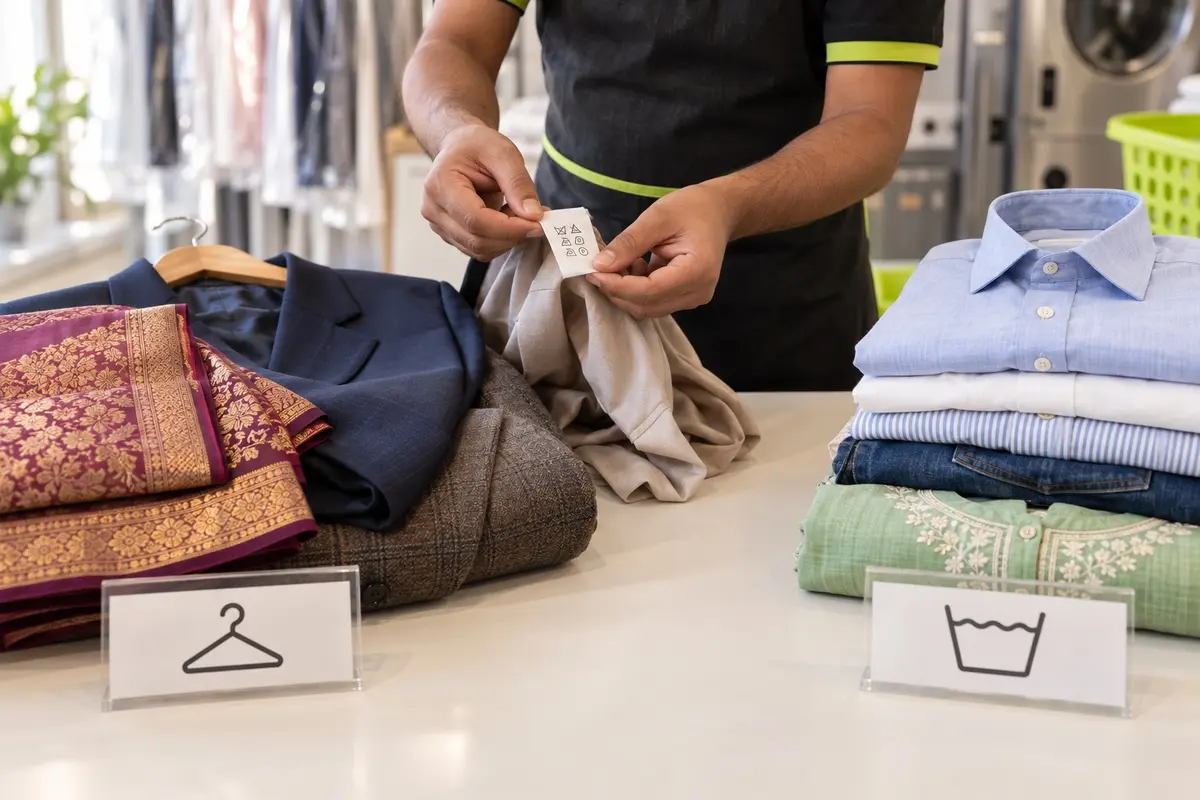
The thirty-second version
- Wash anything cotton, linen, polyester or denim that touches skin every day: shirts, t-shirts, kurtas, jeans, uniforms, bedsheets, towels. Water is what removes sweat, and sweat is what most everyday dirt is.
- Dry clean anything with structure, lining, silk, wool or embellishment: suits, coats, blazers, silk sarees, lehengas, sherwanis, embroidered kurtas, wool sweaters that are heavily soiled, anything whose label shows a circle.
- Premium laundry is the middle road: a separate, gentle wash with softener and a steam-iron finish, for good cotton and linen you do not want treated as bulk.
- When in doubt, the label wins — and if there is no label, treat silk, wool, viscose and anything lined or embroidered as dry clean.
What dry cleaning actually is
The name misleads. Dry cleaning is not dry; it is a wash in a liquid solvent instead of water. The solvent dissolves oils, greases and body soils without the two things water does to delicate fabrics: swelling the fibres so they shrink, and loosening dyes so they bleed. A suit keeps its shape because the wool never swells, the canvas inside the chest never buckles and the lining never puckers. A silk saree keeps its colour because the dye was never invited to move.
What solvent does badly is the other half of dirt. Sweat, most food, tea, cola, blood and anything else water-based do not dissolve in solvent, which is why a good dry cleaner “spots” every water-based mark by hand before the garment goes into the machine. If a cleaner skips that step, the stain comes back exactly as it went in, only set harder by the heat of finishing. This is the single biggest difference between a careful dry cleaner and a cheap one, and it is invisible on the price list.
Dry cleaning is also not sterilising. A suit that has been dry cleaned is clean, but it has not been through hot water. For most garments that does not matter. For a child’s cotton school uniform it does, which is one reason you should not dry clean things that can be washed.
What a proper wash does better
Water plus detergent removes sweat, salt, skin and everyday grime better than any solvent, and it does it by the kilo rather than by the piece. At our Laxmi Nagar outlet wash and fold is ₹70 per kg after the standard discount, and a kilo is roughly four shirts or three pairs of jeans. Dry cleaning a shirt is ₹110. A family that dry cleans its everyday cotton is paying six or seven times more than it needs to, for a result that is actually worse, because the sweat is still in the collar.
The trade-off is that water is rough. It swells cotton, which is why a new shirt shrinks a little in its first wash and why a cheap t-shirt loses its shape by the tenth. Machines add agitation, which is what pills a sweater and frays a seam. A proper laundry manages both: cold water for colours, a separate cycle for whites, low agitation for anything knitted, and every customer’s load kept on its own, never mixed with another household’s to fill a drum. That last point is what stops someone else’s red dupatta turning your white shirts pink.
Reading the care label in five seconds
Every label carries the same five symbols, and only two of them matter for this decision. A tub of water means the garment can be washed; the number inside is the maximum temperature and a hand in the tub means hand wash only. A circle means dry clean; a letter inside (usually P or F) tells the cleaner which solvent, and a circle with a cross through it means do not dry clean. A tub with a cross through it means do not wash in water at all — that is the one people ignore most, and it is the one that costs them a garment.
| Label shows | It means | Send it for |
|---|---|---|
| Tub with a number (30, 40, 60) | Machine washable at up to that temperature | Wash & fold, wash & steam iron, or premium laundry |
| Tub with a hand | Hand wash only, cold | Premium laundry (gentle cycle) or dry cleaning |
| Tub with a cross | Never put it in water | Dry cleaning only |
| Plain circle, or circle with P or F | Dry clean; the letter is for the cleaner | Dry cleaning |
| Circle with a cross | Do not dry clean | Hand wash or premium laundry, and tell us the label says so |
| Both a tub and a circle | Either is safe | Wash for sweat and everyday wear; dry clean for structure and stains |
No label, or a label that has faded? Treat silk, wool, viscose, rayon and anything lined, structured or embellished as dry clean.
Fabric by fabric
The label is the rule; the fabric is the reason behind it. Once you know why each material behaves the way it does, most labels become predictable.
| Fabric | Usual verdict | Why |
|---|---|---|
| Cotton, linen | Wash | Strong wet, holds up to water and heat; may shrink slightly on the first wash. Linen creases, so ask for a steam-iron finish. |
| Polyester, nylon, blends | Wash | Does not shrink or bleed; dries fast. Dry cleaning adds nothing. |
| Denim | Wash, cold, inside out | Indigo dye rubs off in water, so keep it cold and away from whites. |
| Silk | Dry clean | Weak when wet, dyes bleed and water leaves rings. Some plain silks hand-wash, but a saree, dupatta or silk blouse is not the place to find out. |
| Wool, cashmere | Dry clean, or a dedicated cold woollen wash | Heat and agitation felt the fibres permanently. Everyday knits can go on a woollen cycle by the kilo; suits, coats and shawls are dry cleaned. |
| Viscose, rayon, modal | Dry clean | Loses up to a fifth of its strength when wet, stretches on the hanger and shrinks in the dryer. The most common “it shrank” complaint we hear. |
| Leather, suede | Neither — specialist clean | Water stiffens it and solvent strips its oils; leather cleaning is a separate process with conditioning afterwards. |
| Anything with sequins, zari, beads or fusible lining | Dry clean | Water dissolves the glue under sequins and rusts metallic zari; a lining that is fused rather than stitched bubbles when it gets wet. |
Garment by garment, with what it costs
This is the table most people actually want. The wash figure assumes the garment is sent by the kilo; the dry cleaning figure is per piece. Both are Laxmi Nagar rates after the standard 20% discount.
| Garment | Our verdict | Wash (per kg) | Dry clean (per piece) |
|---|---|---|---|
| Cotton shirt, t-shirt | Wash | ₹70/kg, about 4 shirts | ₹110 / ₹90 |
| Trousers, jeans | Wash | ₹70/kg, about 3 pairs | ₹130 / ₹120 |
| Cotton kurta, pyjama | Wash; dry clean if embroidered | ₹70/kg | ₹120 / ₹110 |
| Coat, blazer, jacket | Dry clean | — | ₹225 |
| Suit, two piece / three piece | Dry clean; press between cleans | — | ₹335 / ₹440 |
| Saree, silk or embroidered | Dry clean | — | ₹230, blouse ₹60 |
| Saree, plain cotton | Wash | ₹70/kg | ₹230 if you prefer |
| Lehenga | Dry clean | — | ₹1,000 |
| Dress, skirt | Depends on fabric; dry clean if lined | ₹70/kg | ₹250 / ₹150 |
| Dupatta, shawl | Dry clean | — | ₹100 / ₹300 |
| Sweater, everyday | Woollen wash by the kilo | ₹220/kg woollen | ₹250 full sleeve |
| School uniform, workwear | Wash, hot for whites | ₹70/kg | — |
| Bedsheets, towels | Wash | ₹70/kg | ₹150 / ₹200 per sheet |
Wash & fold is machine washed, tumble dried and folded. Wash & steam iron, at ₹120 per kg, adds pressing. See the dry cleaning page for the full per-item list and the Delhi cost guide for market ranges.
The three decisions people get wrong
1. Dry cleaning a sweaty suit and wondering why it still smells
Sweat is water-based, and solvent does not touch it. A suit that has been through a Delhi summer needs its underarms and collar spotted with a water-based treatment before it goes into the solvent. Ask whether the cleaner spots before cleaning; if the answer is a blank look, go elsewhere. Between cleans, a suit that is merely creased needs a press, not a clean — a two-piece press is ₹110 against ₹335 for a full clean, and dry cleaning more than two or three times a season dulls the cloth.
2. Hand washing a silk saree because the shop said it was fine
Some plain silks survive a cold hand wash. Sarees with zari, a printed border or a contrast pallu very often do not: the metallic thread dulls, the print bleeds into the body and water leaves a tide mark that no amount of ironing removes. At ₹230 for a saree clean, the experiment is not worth the risk on anything you would mind losing.
3. Reading “dry clean only” on a plain cotton kurta and obeying it
Manufacturers put “dry clean only” on garments to protect themselves, not you. A plain, unlined cotton kurta with no embroidery washes perfectly well in cold water, and washing it removes the sweat that dry cleaning leaves behind. The label is a floor, not a ceiling: obey a tub-with-a-cross, but a plain circle on a plain cotton garment is usually caution, not chemistry. If you are unsure, our front desk will tell you honestly which one it needs when the rider collects it.
Premium laundry: the option between the two
Good cotton shirts, linen trousers, hand-block-printed kurtas and children’s better clothes sit awkwardly between bulk laundry and dry cleaning. They do not need solvent, but you do not want them tumbled with the towels. Premium laundry, at ₹175 per kg, washes them on their own with liquid detergent and softener, steam-irons every piece, adds a light fragrance and packs each garment individually. It costs more than wash and fold and considerably less than dry cleaning, and for most of a professional wardrobe it is the right answer.
A simple way to sort the basket: everyday and children’s clothes go in the wash-and-fold pile; office shirts, linen and good cotton go to premium; anything with a circle, a lining, silk, wool or embroidery goes to dry cleaning. Send all three on one pickup and they come back on one bill.
How often each garment needs cleaning
Over-cleaning wears clothes out faster than wearing them. Water fades and thins cotton; solvent and finishing heat gradually dull wool and silk. The right frequency is about soil, not habit.
| Garment | How often | Note |
|---|---|---|
| Shirts, t-shirts, underwear, socks | Every wear | Sweat sets into collars within a day or two in summer. |
| Jeans, trousers | Every 3–5 wears | More often in the monsoon; air them in between. |
| Suit, blazer | Clean 2–3 times a season; press as needed | Hang on a broad hanger with a day off between wears. |
| Sweater, cardigan | Every 5–8 wears, and once before storage | Airing overnight does more than washing. |
| Saree, lehenga, sherwani | After each occasion | Even if it looks clean: food, perfume and sweat set invisibly over months in a cupboard. |
| Bedsheets, pillow covers | Weekly | Fortnightly in winter is acceptable. |
| Curtains | Twice a year | Delhi dust is the reason; see curtain cleaning. |
What a week actually costs, done the right way
Take a household of two working adults and a child. In a typical week they produce about five kilos of everyday washing, four office shirts and one pair of good trousers that deserve better than bulk, and one item — a blazer, a silk kurta, a dupatta — that must be dry cleaned. At Laxmi Nagar rates that is ₹350 for the wash and fold, roughly ₹260 for one and a half kilos of premium laundry, and ₹225 for the blazer: about ₹835 for the week, collected and delivered free because it clears the ₹500 threshold. Dry clean the whole basket instead and the same week costs well over ₹2,500, and the shirts still have sweat in the collars. Sending everything by the kilo, including the blazer, saves money once and costs a blazer.
What is safe to do at home
A home machine on a cold cycle handles cotton, polyester and denim well, and a wool or hand-wash setting with cold water can cope with a light sweater if it is dried flat. Everything in the dry-clean column is safer sent out, for the reasons in the fabric table, and so is anything white you care about: home machines rarely get hot enough to keep whites white without bleach, and bleach is what yellows them over time. The rule we give our own families is simple. If losing the garment would annoy you for a week, do not test it in the machine.
Dry cleaning versus washing: your questions answered
What is the difference between dry cleaning and washing?
Washing cleans with water and detergent; dry cleaning cleans with a liquid solvent and no water. Water removes sweat and water-based dirt best but swells fibres and loosens dyes. Solvent removes oils and grease without shrinking or bleeding, which is why structured, silk, wool and embellished garments are dry cleaned.
How do I know if something needs dry cleaning?
Check the label: a circle means dry clean, a tub with a cross means never use water. If there is no label, treat silk, wool, viscose, rayon and anything lined, structured or embroidered as dry clean. Plain cotton, linen, polyester and denim can be washed.
Is dry cleaning better than washing?
Neither is better; they do different jobs. Dry cleaning protects shape, colour and delicate fibres. Washing removes sweat and everyday soil more thoroughly and costs far less per garment. Everyday cotton should be washed; suits, silk and wool should be dry cleaned.
Does dry cleaning remove sweat and body odour?
Not on its own. Sweat is water-based and does not dissolve in solvent, so a careful cleaner hand-treats collars and underarms with a water-based spotter before the garment goes into the machine. Ask whether stains are spotted before cleaning; it is the step that separates a good dry cleaner from a cheap one.
Can I wash a “dry clean only” garment at home?
Sometimes. A plain, unlined cotton or polyester garment with a cautionary dry-clean label usually washes fine in cold water. Silk, wool, viscose, lined or embellished pieces should not be tested. A tub-with-a-cross symbol always means keep it out of water.
How much does dry cleaning cost compared with laundry in Delhi?
At ClanClean’s Laxmi Nagar outlet wash and fold is ₹70 per kg, wash and steam iron ₹120 per kg and premium laundry ₹175 per kg. Dry cleaning is per piece: a shirt ₹110, a two-piece suit ₹335, a saree ₹230, a lehenga ₹1,000, all after the standard 20% discount. Prices may vary, so confirm the current rate with the outlet before booking.
Does dry cleaning shrink clothes?
No. Shrinking happens when fibres swell in water and then dry under heat. Dry cleaning uses no water, which is exactly why it is used for wool, silk and structured garments. Almost all shrinking we see comes from home machines on a warm cycle.
Should a suit be dry cleaned after every wear?
No. Dry clean a suit two or three times a season and have it pressed in between; more than that wears the cloth. A two-piece press is ₹110 at Laxmi Nagar against ₹335 for a full clean. Hang it on a broad hanger and give it a day off between wears.
Can silk sarees be washed instead of dry cleaned?
Plain silks sometimes survive a cold hand wash, but sarees with zari, printed borders or contrast colours usually do not: the zari dulls, dyes bleed and water leaves rings. For anything you would mind losing, dry cleaning at ₹230 is the safe option.
What is premium laundry and when should I choose it?
Premium laundry is a separate, gentle wash with liquid detergent and softener, a steam-iron finish and individual packing, at ₹175 per kg. Choose it for office shirts, linen and good cotton that do not need solvent but should not be tumbled with towels. It sits between wash and fold and dry cleaning in both care and cost.
How long do dry cleaning and laundry take?
Laundry comes back in 48 hours, steam ironing in 24 hours and dry cleaning in 72 hours as standard. Express is available at about twice the standard rate, confirmed before we take the garment: in by 4 pm for same-day return, after 4 pm for next-day.
Not sure which pile something belongs in?
Book a free doorstep pickup across East and South Delhi and our front desk will sort it honestly — wash, premium or dry clean — and confirm the price before anything is cleaned. Free pickup and delivery on orders over ₹500, and 20% off every order.
Where we pick up and deliver
Every order is collected, cleaned and returned by one of our three shops: Laxmi Nagar in East Delhi, and Malviya Nagar and Sarvapriya Vihar in South Delhi. There is nothing to drop off — the rider comes to your door.
South Delhi pickup areas: Saket, Hauz Khas, Green Park, Greater Kailash 1, Greater Kailash 2, Defence Colony, Lajpat Nagar, CR Park, South Extension, Sarojini Nagar, Panchsheel Park, Mehrauli.
East Delhi pickup areas: Mayur Vihar Phase 1, Patparganj, Karkardooma, IP Extension. Each shop’s page lists every locality it covers.