

Suit, Blazer and Coat Dry Cleaning in Delhi: Cost, How Often and How Long It Takes
A suit is the most expensive thing in most wardrobes and the one most often cleaned wrongly: too often, too late, or one half at a time. This guide covers what a suit, blazer or coat costs to dry clean in Delhi, how often it actually needs it, how long it takes, when a press is enough, and how to get through the wedding season without a last-minute panic.
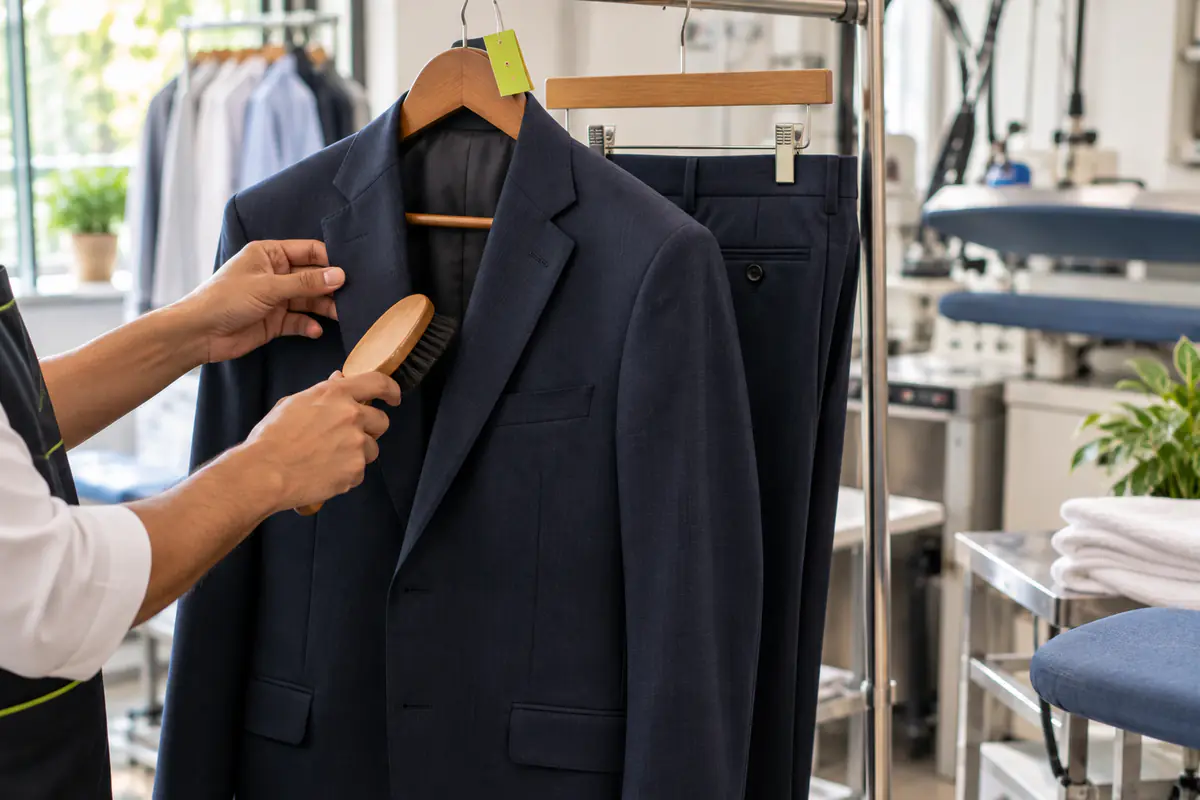
The thirty-second version
- Cost: a coat or blazer is ₹225, a two-piece suit ₹335 and a three-piece suit ₹440 to dry clean at Laxmi Nagar.
- How often: a suit in weekly rotation needs a full clean two or three times a season, not after every wear. Between cleans it needs a brush, a night on a proper hanger and, when creased, a press.
- How long: 72 hours as standard. A steam press alone comes back in 24 hours: ₹50 for a coat, ₹110 for a two-piece suit.
- Always send the jacket and trousers together. Cleaned separately they drift apart in shade, and a suit that no longer matches is two odd garments.
What suit, blazer and coat dry cleaning costs
| Item | Dry cleaning | Steam press only |
|---|---|---|
| Coat or blazer | ₹225 | ₹50 |
| Suit, 2 piece (jacket and trousers) | ₹335 | ₹110 |
| Suit, 3 piece (with waistcoat) | ₹440 | ₹130 |
| Jacket | ₹225 | ₹60 |
| Trousers | ₹130 | ₹30 |
| Shirt | ₹110 | ₹30 |
| Long coat or overcoat (woollen) | ₹300 | — |
| Woollen jacket, full / half sleeves | ₹260 / ₹230 | — |
| Leather jacket | ₹450 | — |
Laxmi Nagar outlet, per piece, after the standard 20% discount that applies to every order with no minimum. Turnaround is 72 hours for dry cleaning and 24 hours for steam pressing. Sherwanis, bandhgalas with heavy work and anything embellished are priced at the counter on inspection. Every other garment is in our Delhi laundry and dry cleaning cost guide, which has a calculator.
Two things move the price of a suit clean anywhere in Delhi: what the garment is, and what has happened to it. A plain wool-blend office suit is the base rate. Linen, velvet, a silk lining, hand embroidery or a stain that needs an hour on the spotting board is more work, and an honest counter tells you so before it takes the garment, not when you collect it. If a quote is far below the going rate, ask whether the jacket is cleaned in fresh solvent and pressed by hand or run through with everything else; on a structured garment that difference shows within three cleans.
How often a suit really needs dry cleaning
Less often than most people think. A suit jacket rarely touches skin; the shirt takes the sweat. What a jacket collects is dust, the smell of the day, and creases at the elbow and the back. None of that needs solvent. Dry cleaning is gentle, but every clean and press takes a little life out of the cloth and the canvas that gives the chest its shape, and a suit cleaned weekly looks tired in two years instead of eight.
| How it is worn | Full dry clean | In between |
|---|---|---|
| Office suit, worn once a week | Two or three times a season | Brush and air after each wear; press when creased |
| Blazer worn most days | Every four to six weeks | Rotate with a second blazer; press fortnightly |
| Wedding or function suit | After every function | Food, perfume and sweat set invisibly in storage |
| Suit worn in Delhi summer or on a commute | After three or four wears | Sweat reaches the lining; do not let it sit |
| Trousers | Twice as often as the jacket — but send both | Press between cleans |
| Winter overcoat | Once, at the end of winter, before storage | Brush; spot clean the collar and cuffs |
The signs that a suit needs a clean and not just a press: a smell that survives a night of airing, a shine or darkening at the collar and cuffs, any visible stain, or a lining that feels stiff under the arms. And one rule with no exceptions: clean it before it goes into storage. Moths and silverfish are drawn to what is on the wool, not the wool itself, and a suit put away after a wedding with a little gravy on the sleeve comes out in October with a hole where the gravy was.
When a press is enough
Most of the time. If the suit is clean but creased — after a flight, a long day in a car, or six months on a crowded rail — a steam press restores it for about a third of the cost of a clean: ₹110 against ₹335 for a two-piece at Laxmi Nagar, back in 24 hours. Professional pressing is done on shaped bucks that follow the chest, shoulder and sleeve, which is why it looks different from a home iron; a flat iron on a suit jacket flattens the lapel roll and leaves a shine on the cloth that does not come out. If you must iron at home, use a damp cotton cloth between the iron and the suit and never press the lapel flat. Our steam ironing page has the full per-garment list.
Never press a dirty suit. Heat sets stains and bakes perspiration into the fibre. If there is a mark or a smell, it needs cleaning first; pressing over it makes the mark permanent.
How long suit dry cleaning takes
Seventy-two hours is our standard for coats, suits and blazers, and it is a fair benchmark for any careful cleaner in Delhi. The time is not the machine, which runs for under an hour. It is the inspection and tagging, hand spotting of stains before the clean, the clean itself, airing so no solvent smell remains, and then the pressing, which on a suit is three separate jobs: jacket body, sleeves and trousers. A stain that needs a second treatment, a velvet or linen suit, or a bandhgala with handwork adds a day. Express service is available for most garments at about twice the standard rate and is confirmed before we take the garment; see express and same-day service.
The practical rule for functions: send the suit a full week before you need it. That leaves room for a second pass on a stubborn stain and for the November rush, when every counter in the city is full of sherwanis and lehengas. Our lehenga and wedding outfit guide has the same timeline for the bride’s side.
What actually happens to your suit
- Inspection at pickup or the counter. Pockets emptied, stains noted with what caused them if you know, loose buttons and open seams pointed out before cleaning, not after.
- Spotting. Water-based stains — chai, food, sweat at the collar — do not dissolve in dry cleaning solvent, so they are treated by hand first. This is where the skill is, and why telling us what the stain is matters.
- Cleaning. The suit is cleaned in solvent, not water, so the wool does not swell, the canvas inside the chest does not shrink away from the cloth and the lining does not pucker. Our dry clean vs wash guide explains why structured garments cannot be washed.
- Pressing and finishing. Jacket on a shaped form, sleeves on a sleeve board, trousers creased on the original line. Lapels are rolled, not flattened.
- Return on a hanger, in a cover. Take the plastic cover off when it reaches home; it is for the journey, not the cupboard.
Blazers, linen, velvet and sherwanis
Blazers and sports coats
Worn more casually and more often than a suit jacket, usually with nothing to match, so they can be cleaned alone. The collar and the cuffs are where they age; a blazer worn daily should alternate with a second one so each gets a day on the hanger to drop its creases and dry out.
Linen and cotton suits
Delhi summer suits. They crease by design, show sweat quickly and need cleaning more often than wool — after three or four wears. They are still dry cleaned, not washed, because the structure inside the jacket is the same as a wool suit.
Velvet and corduroy
The pile crushes under a flat iron and never recovers. These are steamed, not pressed. Do not attempt them at home, and never fold velvet for storage.
Sherwanis, bandhgalas and Nehru jackets
Treated like the embellished garments they are: handwork protected, buttons covered or removed, cleaned gently and hand finished. They are priced on inspection because a plain bandhgala and a zardozi sherwani are entirely different amounts of work. Send them within a few days of the function; haldi, food and perfume are far easier to remove in the first week than the first month. The saree care guide covers the other half of the wedding wardrobe.
Looking after a suit between cleans
- Hang it on a broad, shaped hanger the moment it comes off. A wire hanger puts a permanent dent in the shoulder within weeks.
- Brush it with a soft clothes brush, downwards, after each wear. Delhi dust works into the weave and acts like sandpaper on the fibres.
- Give it a day off. Wool recovers its shape and releases moisture overnight; a suit worn two days running creases twice as fast.
- Empty the pockets. Keys and a phone stretch the pocket bags and pull the front out of line.
- Hang trousers by the hem or folded over a padded bar, along the crease.
- Blot spills, never rub, and do not put water on a wool suit; it leaves a ring. The first-aid steps are in our stain removal guide.
- Store in a cloth suit cover, never plastic, with a neem or cedar pouch in the cupboard. The full method for the off-season is in the seasonal storage guide.
A Delhi suit calendar
September and October: before the wedding season
Take every suit, blazer and sherwani out, try them on, and check for moth holes, musty smell and fold lines. Send anything that needs cleaning now, while counters are quiet and 72 hours means 72 hours. A suit that only needs its creases dropped gets a press.
November to February: weddings and winter
Clean after every function, press between office wears, and send the jacket and trousers together every time. Overcoats and woollen jackets need only a brush and an airing until the season ends; the winter woollen care guide covers them.
March: before storage
Every woollen suit and overcoat is cleaned once before it is put away, whatever it looks like. This is the clean that prevents moth damage, and the one most people skip.
April to August: summer and monsoon
Linen and cotton suits in rotation, cleaned more often. Open the cupboard and air the stored suits once a month from July to September; humidity is what turns a closed wardrobe musty.
Suit and blazer dry cleaning: your questions answered
How much does it cost to dry clean a suit in Delhi?
At ClanClean’s Laxmi Nagar outlet a two-piece suit is ₹335 and a three-piece suit ₹440 after the standard 20% discount, with a 72-hour turnaround. A coat or blazer alone is ₹225 and trousers ₹130. Prices may vary, so confirm the current rate with the outlet before booking.
How much does blazer dry cleaning cost?
A blazer or coat is ₹225 to dry clean at ClanClean Laxmi Nagar after the standard 20% discount, and ₹50 for a steam press alone. Linen, velvet, embroidered or heavily stained blazers can cost more because they need hand work. Prices may vary, so confirm the current rate with the outlet before booking.
How long does it take to dry clean a suit?
72 hours as standard. The machine cycle is under an hour; the rest is inspection, hand spotting of stains, airing and three separate pressing jobs for the jacket body, sleeves and trousers. Express service is available for most garments at about twice the standard rate. Before a function, send the suit a full week ahead.
How often should a suit be dry cleaned?
A suit worn once a week needs a full clean two or three times a season. Clean it sooner if there is a stain, a smell that survives a night of airing, or a shine at the collar and cuffs, and always after a wedding or function and before long storage. Between cleans, brush it, hang it properly and have it pressed.
Can I dry clean only the trousers and not the jacket?
You can, but for a matched suit it is a mistake. Each clean shifts the shade very slightly, and trousers cleaned four times next to a jacket cleaned once stop matching. Send both pieces together every time, even if only one looks dirty. Blazers and odd trousers can be cleaned separately.
Is it better to dry clean or just press a suit?
If the suit is clean but creased, press it: ₹110 for a two-piece at Laxmi Nagar against ₹335 for a clean, and back in 24 hours. If there is any stain or smell, clean it first. Never press a dirty suit, because heat sets stains and perspiration permanently.
Can a suit or blazer be washed at home?
No. A tailored jacket has a canvas or fused layer inside the chest, shoulder pads and a lining, and each reacts differently to water. Washing shrinks them at different rates, so the front bubbles and the lining hangs below the hem. Unstructured cotton blazers labelled washable are the only exception.
Does dry cleaning damage a suit?
Not when it is needed, but every clean and press takes a little life out of the cloth, so cleaning a suit weekly ages it faster than wearing it. The real damage comes from the opposite mistake: storing a suit uncleaned, which sets stains and attracts moths. Two or three cleans a season is the balance.
How much does it cost to dry clean a sherwani?
Sherwanis, heavily worked bandhgalas and embellished jackets are priced on inspection at the counter, because the embroidery, buttons, lining and stains decide the work. A plain coat is ₹225 at Laxmi Nagar as a reference point. Send it within a few days of the function, before haldi, food and perfume set.
How should I store a suit after dry cleaning?
Take off the plastic cover, which traps damp, and hang the suit on a broad shaped hanger inside a cloth suit cover. Keep a neem or cedar pouch in the cupboard, leave space between garments, and air the wardrobe once a month during the monsoon. Never store a suit that has been worn but not cleaned.
Send the suit, skip the queue
Free doorstep pickup across East and South Delhi. Tell the rider where the stains are and when you need it back, and it returns cleaned, hand pressed and on a hanger. Free pickup and delivery on orders over ₹500, and 20% off every order.
Where we pick up and deliver
Every order is collected, cleaned and returned by one of our three shops: Laxmi Nagar in East Delhi, and Malviya Nagar and Sarvapriya Vihar in South Delhi. There is nothing to drop off — the rider comes to your door.
South Delhi pickup areas: Saket, Hauz Khas, Green Park, Greater Kailash 1, Greater Kailash 2, Defence Colony, Lajpat Nagar, CR Park, South Extension, Sarojini Nagar, Panchsheel Park, Mehrauli.
East Delhi pickup areas: Mayur Vihar Phase 1, Patparganj, Karkardooma, IP Extension. Each shop’s page lists every locality it covers.